By Aaru Life Science | April 2026
Introduction
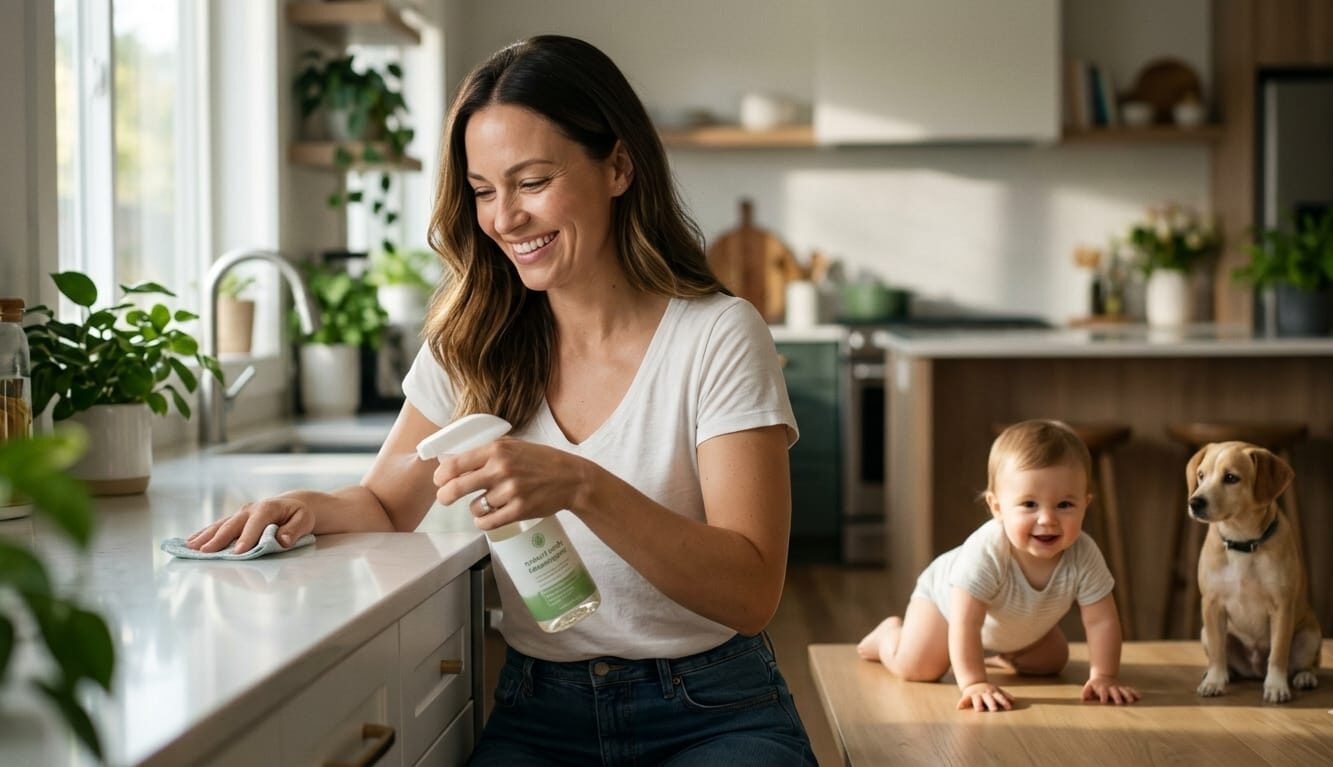
You scrub the floors, wipe down counters, and spray the bathroom until everything sparkles. And then your toddler crawls across that freshly mopped floor, or your dog licks their paws after walking through the kitchen.
That thought alone is enough to make you rethink what’s actually in your cleaning cabinet.
According to the ASPCA Animal Poison Control Center, household cleaning products are involved in 8.3% of all pet poison calls (Maids of Movher, 2026). And a study found that children who are regularly exposed to conventional household cleaners face elevated risks of respiratory issues including asthma. The problem isn’t just what you can smell it’s what lingers invisibly on surfaces long after you’ve finished cleaning.
The good news? You don’t have to choose between a clean home and a safe one. These 5 natural cleaning chemicals actually work without putting your family at risk.
Key Takeaways
- Household cleaning products are involved in 8.3% of all pet poison calls (ASPCA).
- Children breathe faster and absorb more chemicals per body weight than adults making them more vulnerable to VOCs and chemical residues.
- Natural, plant-based, and enzyme-based cleaners can match conventional products in cleaning power without toxic residue.
- Key chemicals to avoid: ammonia, chlorine bleach, phenols, formaldehyde, phthalates, and synthetic fragrances.
- Look for certifications: EPA Safer Choice, EWG Verified, Green Seal, or Leaping Bunny.
Why Kids and Pets Are More Vulnerable Than You Think
Before we get into the solutions, it’s worth understanding why this matters so much for young children and animals specifically.
Children and pets spend most of their time low to the ground exactly where cleaning chemical residues settle and concentrate. A toddler’s skin is thinner and more absorbent than an adult’s. Their respiratory rate is also faster, meaning they inhale more air per kilogram of body weight. According to HealthyChildren.org (2026), these developmental and behavioral factors crawling, touching everything, putting hands in mouths put children at significantly higher exposure risk than adults.
Pets face the same challenges. Dogs and cats walk across cleaned floors, then groom their paws. Cats are especially sensitive because their livers can’t process certain compounds the way human livers can.
The Environmental Working Group found 530 different Volatile Organic Compounds (VOCs) across cleaning products 193 of which were considered hazardous (Organically Becca, 2025). VOC concentrations indoors can reach up to 10 times higher than outdoors after a cleaning session. That’s the air your children and pets are breathing.
[INTERNAL-LINK: Dr. Home natural cleaning products → Dr. Home product category page]
5 Natural Cleaning Chemicals That Actually Work
1. Baking Soda (Sodium Bicarbonate)
Baking soda is one of the most versatile and genuinely safe cleaning agents you can use at home. It works as a mild abrasive for scrubbing surfaces, a natural deodorizer for carpets and upholstery, and a gentle pH balancing agent for cutting through grease and grime.
It’s non-toxic, biodegradable, and leaves zero harmful residue. Your toddler could lick a surface cleaned with baking soda and be completely fine which is more than you can say for most commercial cleaners.
Best used for: Scrubbing sinks, deodorizing carpets and pet bedding, cleaning stovetops, and baking soda based paste for tough stains.
2. White Vinegar (Diluted Acetic Acid)
White vinegar has natural antimicrobial properties, making it genuinely effective against common household bacteria. At 5-8% acidity, diluted white vinegar can disinfect surfaces, cut through soap scum, and leave glass and mirrors streak-free.
It’s one of the most researched natural cleaning agents, and its safety profile is well-established. It breaks down completely after use and leaves no toxic residue.
One important note: don’t use vinegar on natural stone surfaces like marble or granite, as the acidity can cause etching. Also, while vinegar is safe for most pets in diluted form, don’t use strong concentrations around cats, who are sensitive to strong acidic odors.
Best used for: Glass, mirrors, tile grout, hard water deposits, bathroom surfaces, and general disinfecting.
3. Plant-Based Surfactants (Castile Soap / Coconut-Derived Cleansers)
Castile soap traditionally made from olive oil, and now available in coconut and other plant oil versions is a powerful degreaser and all-purpose cleaner that’s completely biodegradable and free of synthetic chemicals.
Plant-derived surfactants work by surrounding dirt, grease, and grime particles and lifting them from surfaces, exactly the same mechanism as synthetic surfactants just without the petroleum-based compounds, synthetic fragrances, or phthalates.
According to Green Llama Clean (2025), phthalates often hidden under the word “fragrance” on product labels are endocrine disruptors linked to hormonal issues in both humans and animals. Plant-based surfactants contain none of these.
Best used for: All-purpose cleaning, floor mopping, dish washing, laundry, and as a base for DIY cleaning solutions.
[INTERNAL-LINK: Dr. Home liquid phenyl and cleaning products → product pages]
4. Enzyme-Based Cleaners
Enzyme cleaners are one of the most effective tools for homes with kids and pets — and they’re underused. They work by deploying specific biological enzymes that break down organic matter at a molecular level: urine, vomit, food residue, pet accidents, and biological stains.
Unlike chemical cleaners that simply mask odors with synthetic fragrances, enzyme cleaners actually eliminate the source of the odor. Naturally It’s Clean (2025) explains that enzyme cleaners use natural bacteria to “eat” the mess rather than covering it which is why they’re so effective on pet accidents and organic stains that keep coming back with regular cleaners.
They’re safe for children, safe for pets, biodegradable, and leave no toxic residue. EPA Safer Choice certified enzyme cleaners are available and have been vetted by the Environmental Protection Agency for exactly these safety credentials.
Best used for: Pet urine and accident cleanup, food stains on carpets, organic stains on upholstery, and any biological odor source.
5. Hydrogen Peroxide (3% Dilution)
At the 3% concentration sold in pharmacies, hydrogen peroxide is a safe and effective disinfectant that breaks down into water and oxygen after use leaving no toxic residue whatsoever.
It’s effective against bacteria, mold, and mildew, and is genuinely EPA-registered as a disinfectant at appropriate concentrations. This makes it one of the few natural alternatives that offers real disinfection rather than just cleaning.
Keep it away from colored fabrics (it can bleach), and don’t mix it with vinegar in the same spray bottle (this creates peracetic acid, which can be irritating). But used correctly, it’s an excellent and genuinely safe disinfectant for kitchens, bathrooms, and high-touch surfaces.
Best used for: Bathroom disinfection, mold and mildew removal, kitchen surfaces, cutting boards, and high touch areas during illness.
What to Look For and What to Avoid
When shopping for natural cleaning products, the label can be misleading. “Natural” is an unregulated term in the cleaning industry (Maids of Movher, 2026). A product can call itself natural while still containing synthetic fragrances, phthalates, or quaternary ammonium compounds.
Chemicals to avoid around kids and pets:
- Ammonia respiratory irritant, dangerous for pets with sensitive airways
- Chlorine bleach (sodium hypochlorite) fumes irritate airways; never mix with ammonia
- Phenols highly toxic to cats specifically
- Formaldehyde known carcinogen, sometimes used as a preservative
- Phthalates often hidden under “fragrance,” endocrine disruptors
- Quaternary ammonium compounds (QACs/”quats”) skin and respiratory irritants
Certifications to look for:
- EPA Safer Choice every ingredient reviewed and approved for safety
- EWG Verified Environmental Working Group verification
- Green Seal Certified meets rigorous environmental standards
- Leaping Bunny cruelty-free manufacturing
Frequently Asked Questions
Are natural cleaning products as effective as chemical ones?
Yes for most household cleaning tasks. Plant-based surfactants remove dirt and grease as effectively as synthetic alternatives. Enzyme cleaners outperform chemical cleaners on organic stains and odors. Baking soda and vinegar handle 80% of everyday cleaning needs. The only area where natural alternatives sometimes fall short is heavy-duty industrial disinfection but for home use, they’re more than adequate (Naturally It’s Clean, 2025).
Is white vinegar safe to use around cats and dogs?
Diluted white vinegar (mixed with water at 1:1 or 1:2 ratio) is generally safe for use around dogs and is a commonly recommended natural cleaner. Cats are more sensitive to strong odors and acidic compounds, so keep concentrations low and ensure good ventilation. Avoid using vinegar directly on pets (Avail Pet, 2026).
What should I use to clean floors that are safe for crawling babies and pets?
For floors, plant-based castile soap diluted in warm water is ideal. Enzyme-based floor cleaners are also excellent, especially if you have pets prone to accidents. Always allow floors to dry completely before letting children or pets back on the surface even safe cleaners can cause slipping or minor irritation when wet (PÜR Evergreen, 2025).
How do I know if a product labeled “natural” is actually safe?
Look for third-party certifications rather than relying on the label claim. EPA Safer Choice, EWG Verified, and Green Seal are independently verified certifications that mean the product’s ingredients have been reviewed. If a product lists “fragrance” as an ingredient without disclosing the component chemicals, that’s a red flag fragrance formulations can legally contain hundreds of undisclosed chemicals (Green Llama Clean, 2025).
Are enzyme cleaners safe for septic systems?
Yes enzyme cleaners are actually beneficial for septic systems. The natural bacteria and enzymes they contain can help maintain the biological balance in a septic tank. Unlike harsh chemical cleaners that kill the beneficial bacteria in your septic system, enzyme cleaners work in harmony with it (Naturally It’s Clean, 2025).
Conclusion
Switching to natural cleaning chemicals isn’t about being perfect it’s about making informed choices that protect the people (and animals) who matter most to you.
Baking soda, diluted white vinegar, plant-based surfactants, enzyme cleaners, and diluted hydrogen peroxide will handle the overwhelming majority of your household cleaning needs. They clean effectively, leave no toxic residue, and won’t put your kids or pets at risk.
At Aaru Life Science, our Dr. Home range is built around exactly this philosophy effective home cleaning formulas that are safe for your family and gentle on the environment. Because a clean home shouldn’t come at the cost of a safe one.
[INTERNAL-LINK: shop Dr. Home products → Dr. Home product category]
Sources:
- Maids of Movher (2026): https://www.maidsofmovher.com/is-your-clean-house-actually-hurting-your-kids-and-pets
- HealthyChildren.org (2026): https://www.healthychildren.org/English/safety-prevention/all-around/Pages/green-cleaning-choosing-products-that-are-safer-for-your-family.aspx
- Organically Becca (2025): https://organicallybecca.com/low-tox-cleaning-product-brands/
- Naturally It’s Clean (2025): https://naturallyitsclean.com/blogs/the-natural-clean-journal/pet-safe-and-kid-friendly-cleaning
- Green Llama Clean (2025): https://greenllamaclean.com/blogs/news/how-to-choose-pet-safe-baby-safe-natural-cleaners-a-parents-guide
- Avail Pet (2026): https://availpet.com/pet-safe-cleaning-products/
- PÜR Evergreen (2025): https://purevergreen.com/blogs/news/best-non-toxic-cleaning-products-for-families-with-kids-pets