
By Aaru Life Science | April 2026
Introduction
Every metre drilled into the earth is a negotiation between engineering and geology. The wellbore must stay open. Formation fluids must stay out. The drill bit must keep moving. And the drilling crew must do all of this safely, efficiently, and within budget.
Drilling fluid the mud that circulates continuously through every active wellbore is the medium through which most of these objectives are achieved. And the chemicals that formulate, condition, and control that fluid are among the most consequential inputs in any drilling operation.
In 2026, as Indian operators push into more complex reservoirs and international oilfield service companies increasingly source chemicals locally, understanding drilling fluid chemistry has never been more commercially important.
What Drilling Fluid Actually Does
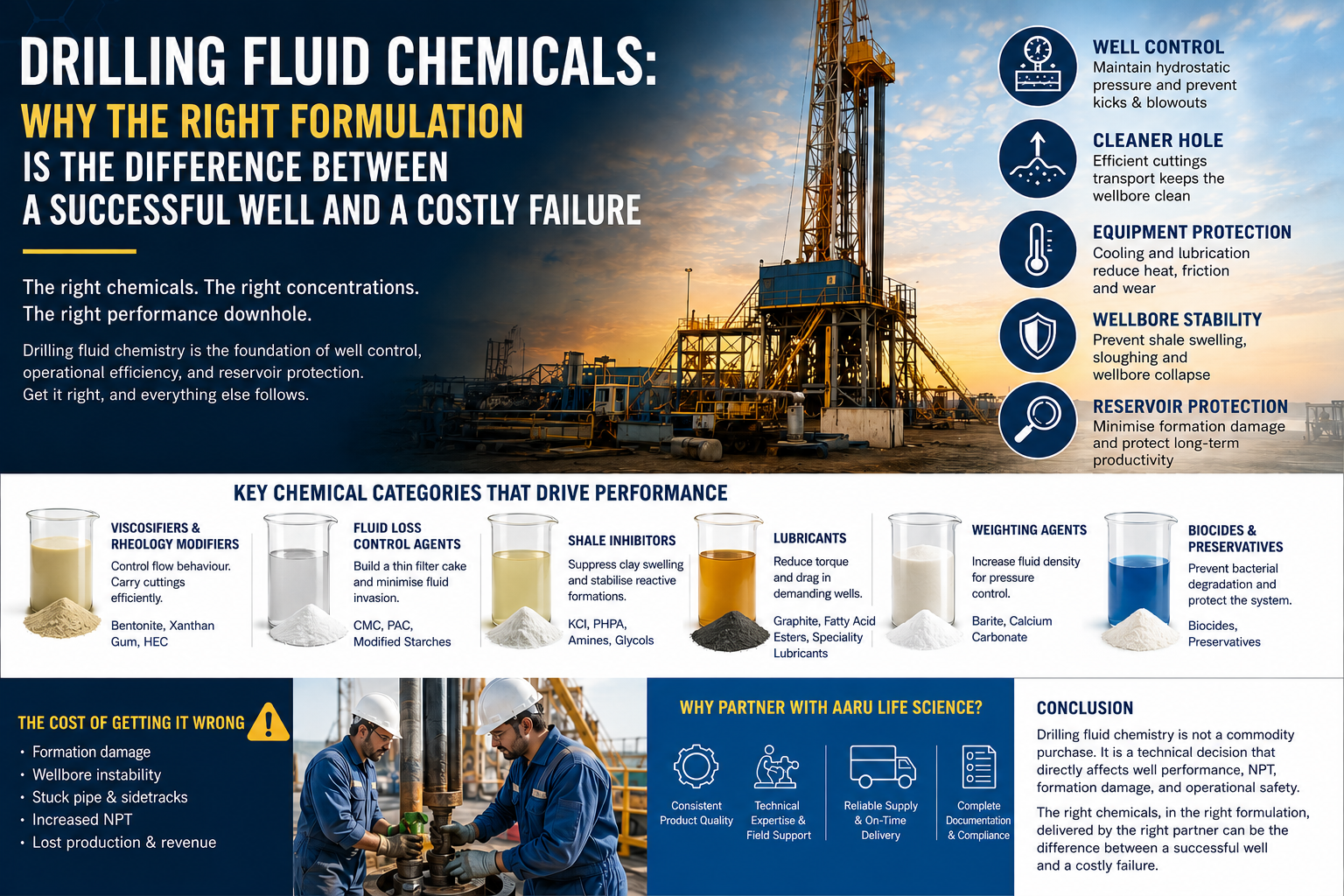
Drilling fluid commonly called drilling mud serves multiple simultaneous functions that are easy to underestimate until something goes wrong:
- Hydrostatic pressure control: The fluid column exerts pressure against formation fluids, preventing kicks and blowouts.
- Cuttings transport: Fluid carries rock cuttings from the bit face to the surface, keeping the hole clean.
- Bit cooling and lubrication: Continuous circulation prevents heat buildup and reduces friction on the drill string.
- Wellbore stability: Chemical interactions between the fluid and formation prevent swelling, sloughing, and collapse.
- Formation evaluation support: Properly formulated fluid minimises formation damage, protecting the reservoir’s producibility.
Each of these functions depends on specific chemical properties and maintaining those properties across changing downhole conditions is what drilling fluid chemistry is all about.
The Key Chemical Categories in Drilling Fluid Formulation
Modern drilling fluid systems use a range of speciality chemicals, each targeting a specific performance objective:
Viscosifiers and Rheology Modifiers. These chemicals control the fluid’s flow behaviour thick enough to carry cuttings when circulation slows, thin enough to flow freely under pump pressure. Bentonite, xanthan gum, and HEC (hydroxyethyl cellulose) are common viscosifiers for water-based systems.
Fluid Loss Control Agents. When drilling fluid filtrate invades the formation, it can damage the reservoir or destabilise the wellbore. Fluid loss agents including CMC (carboxymethyl cellulose), PAC (polyanionic cellulose), and modified starches form a thin filter cake on the wellbore wall that dramatically reduces this invasion.
Shale Inhibitors. Reactive shale formations are among the most common causes of wellbore instability. When water-based drilling fluids contact certain clay minerals, they cause swelling, hydration, and eventual wellbore collapse. Potassium chloride, PHPA (partially hydrolysed polyacrylamide), amine-based inhibitors, and glycols all work to suppress this reaction.
Lubricants. Extended horizontal sections, tight clearances, and high-angle wells generate extreme friction on the drill string. Graphite, fatty acid esters, and speciality lubricants reduce torque and drag keeping drilling parameters within operational limits and protecting equipment.
Weighting Agents. Barite (barium sulphate) is the standard weighting material used to increase fluid density in high-pressure formations. Calcium carbonate serves as an acid-soluble alternative in reservoir sections where formation damage is a concern.
Biocides and Preservatives. Water-based drilling fluid systems are susceptible to microbial degradation bacteria that break down polymers and produce hydrogen sulphide (H2S). Biocides prevent this degradation and protect both the fluid system and the wellbore environment.
The Consequences of Getting the Chemistry Wrong
Drilling fluid failures are rarely catastrophic in a single moment. More often, they manifest as a slow accumulation of non-productive time (NPT) the industry’s most expensive metric.
Consider what poor fluid loss control costs: even a modest increase in formation damage across a reservoir section can reduce well productivity by 10-20%, representing millions of rupees in lost production over the well’s life.
Or consider the cost of wellbore instability caused by inadequate shale inhibition: stuck pipe incidents can cost lakhs of rupees per hour in rig time, and in severe cases require sidetracking the well entirely.
The return on investment from properly formulated drilling fluid using the correct chemicals at the correct concentrations is one of the clearest value propositions in oilfield operations.
Water-Based vs Oil-Based Systems Choosing the Right Platform
Most drilling fluid selection decisions begin with the base fluid:
Water-based mud (WBM) systems are the industry default for most applications. They are lower cost, easier to manage environmentally, and can be formulated for a wide range of conditions using the chemical categories described above. Modern WBM systems with advanced inhibitor packages can handle many formations that previously required oil-based systems.
Oil-based mud (OBM) and synthetic-based mud (SBM) systems offer superior shale inhibition, lubricity, and temperature stability making them the preferred choice for deepwater wells, HPHT conditions, and highly reactive formations. Their higher cost and more complex waste management requirements mean they are typically reserved for applications where WBM cannot perform.
The selection decision involves formation characteristics, regulatory environment, logistics, and economics and the chemical formulation within each system is where operators differentiate their drilling performance.
Sourcing Drilling Fluid Chemicals in India: What to Look For
For operators and drilling contractors sourcing chemicals in India, several factors determine supplier value:
Product consistency: Drilling fluid performance depends on consistent chemical specifications. Batch-to-batch variation in a viscosifier or fluid loss agent means constant reformulation on the rig increasing costs and risk.
Technical data and field support: Good suppliers provide technical data sheets, application guidance, and the ability to troubleshoot fluid performance issues.
Supply reliability: Drilling operations run 24 hours a day. Chemical supply interruption means rig downtime. Local stockholding and reliable logistics are non-negotiable.
Regulatory compliance: Environmental regulations around drilling fluid discharge are tightening in India and internationally. Suppliers should be able to provide environmental safety data for all products.
Aaru Life Science supplies oilfield chemicals to drilling operations across India, including the full range of drilling fluid chemicals from fluid loss agents and shale inhibitors to lubricants and weighting materials. Our team understands oilfield application requirements and provides complete technical documentation with every order.
Conclusion
Drilling fluid chemistry is not a commodity purchase. It is a technical decision that directly affects well performance, non-productive time, formation damage, and operational safety.
The operators and drilling contractors who treat chemical selection as a strategic input sourcing from suppliers who understand the application and provide consistent, documented products consistently outperform those who prioritise price alone.
To explore Aaru Life Science’s oilfield chemical range or discuss your specific drilling application, visit aarulifescience.net or contact our technical team directly.