
By Aaru Life Science | April 2026
Introduction
Water is the one raw material that every industry in India uses and the one that regulators are watching most closely in 2026.
From textile mills in Gujarat to pharmaceutical plants in Hyderabad, from steel facilities in Jharkhand to food processing units across Maharashtra, every industrial operation generates wastewater that must be treated before discharge. And every process that uses water for cooling, cleaning, or as a direct input needs that water to meet specific quality standards.
The result: India’s water treatment chemicals market is experiencing some of its strongest growth in years. And for procurement managers, plant engineers, and EHS teams, understanding which chemicals matter, why, and how to source them reliably has never been more important.
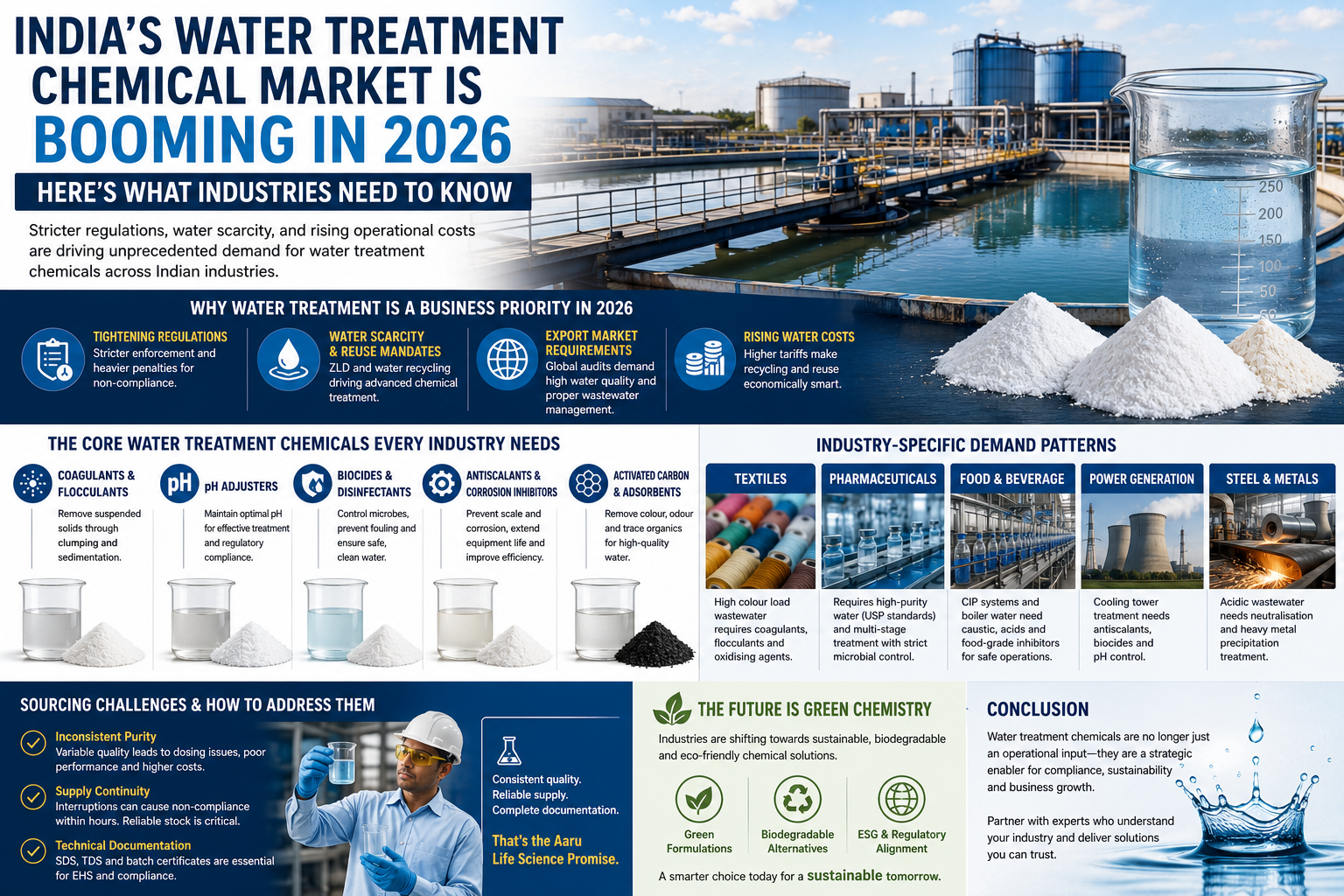
Why Water Treatment Has Become a Business Priority
Several converging forces are driving demand for water treatment chemicals across Indian industry in 2026:
Tightening regulatory enforcement. The Central Pollution Control Board (CPCB) and State Pollution Control Boards have significantly increased monitoring of industrial effluent discharge. Violations now carry real financial and operational consequences not just warnings.
Water scarcity and reuse mandates. In water-stressed states, industries are increasingly required to implement Zero Liquid Discharge (ZLD) systems. This requires more sophisticated chemical treatment programmes at every stage of the water cycle.
Export market requirements. Manufacturers supplying international markets particularly in food, pharma, and textiles face customer audits that include water quality and wastewater management as standard assessment criteria.
Cost pressure from water tariffs. As industrial water costs rise across major manufacturing states, recycling and reuse become economically attractive and both require effective chemical treatment.
The Core Water Treatment Chemicals Every Industry Needs
While specific requirements vary by industry and process, several chemical categories see consistent demand across the board:
Coagulants and Flocculants. These chemicals cause suspended solids to clump together so they can be removed by sedimentation or filtration. Aluminium sulphate (alum), ferric chloride, and polyacrylamide-based flocculants are workhorses of primary effluent treatment.
pH Adjusters. Maintaining correct pH is fundamental to virtually every water treatment process. Sodium hydroxide, sulphuric acid, hydrochloric acid, and sodium carbonate are used to bring effluent streams within acceptable discharge ranges and to optimise downstream treatment.
Biocides and Disinfectants. Cooling water systems, process water loops, and wastewater treatment plants all require microbial control. Sodium hypochlorite, chlorine dioxide, and speciality biocides prevent fouling, legionella growth, and biological contamination.
Antiscalants and Corrosion Inhibitors. In cooling towers, boilers, and reverse osmosis systems, scale formation and corrosion are constant operational challenges. Phosphate-based inhibitors, HEDP, and polyphosphates protect equipment and extend system life significantly.
Activated Carbon and Adsorbents. For industries that need to remove colour, odour, or trace organics from process or wastewater streams, activated carbon remains the most reliable solution.
Industry-Specific Demand Patterns
Different sectors have distinct chemical treatment profiles:
Textiles: High colour load wastewater requires coagulants, flocculants, and oxidising agents. Effluent Treatment Plants (ETPs) in this sector are some of the most chemically intensive in Indian industry.
Pharmaceuticals: Process water must meet USP Purified Water or Water for Injection standards. This requires multi-stage treatment including reverse osmosis, UV disinfection, and strict microbial control.
Food & Beverage: CIP (Clean-in-Place) systems use caustic soda, nitric acid, and sanitisers. Boiler water treatment requires scale and corrosion inhibitors approved for food-contact systems.
Power Generation: Cooling tower treatment is a major chemical spend. Antiscalants, biocides, and pH control chemicals are required continuously.
Steel & Metals: Acid pickling generates highly acidic wastewater requiring neutralisation before treatment. Heavy metal precipitation using lime or sodium sulphide is standard.
Sourcing Challenges and How to Address Them
Industrial buyers of water treatment chemicals frequently encounter several supply challenges:
Inconsistent purity. Particularly for bulk commodities like alum or sodium hydroxide, product quality can vary significantly between suppliers. Inconsistent purity means inconsistent treatment performance leading to dosing problems, compliance failures, and wasted chemical spend.
Supply continuity. For continuous treatment processes, chemical supply interruption is not a minor inconvenience it can cause regulatory non-compliance within hours. Reliable supply from a stocked local distributor matters enormously.
Technical documentation. EHS and compliance teams increasingly require Safety Data Sheets (SDS), Technical Data Sheets (TDS), and batch certificates for all chemicals on-site. Not all suppliers provide these as standard.
At Aaru Life Science, we maintain consistent stock of core water treatment chemicals and provide complete technical documentation with every order. Our team can advise on appropriate chemical selection and dosing for your specific application.
Looking Ahead: Green Chemistry and Water Treatment
One significant trend shaping India’s water treatment chemical market in 2026 is the shift toward greener formulations. Environmental pressure, export requirements, and ESG reporting obligations are pushing industries toward biodegradable alternatives to conventional treatment chemicals.
Phosphonate-free antiscalants, biodegradable flocculants derived from natural polymers, and enzyme-based biocides are all gaining adoption particularly in food, pharma, and consumer-facing industries. This is a market trend that procurement teams should factor into their chemical strategy now, ahead of likely regulatory mandates.
Conclusion
India’s water treatment chemical market in 2026 reflects a broader reality: compliance is no longer optional, water scarcity is intensifying, and the industries that will thrive are those that manage water and the chemicals used to treat it with genuine expertise.
Whether you need bulk coagulants for an ETP, high-purity reagents for a pharmaceutical water system, or speciality inhibitors for cooling tower management, Aaru Life Science can supply what you need with the documentation and reliability your operations demand.
Explore our industrial chemical range at aarulifescience.net or contact our team to discuss your water treatment requirements.