
By Aaru Life Science | April 2026
Introduction
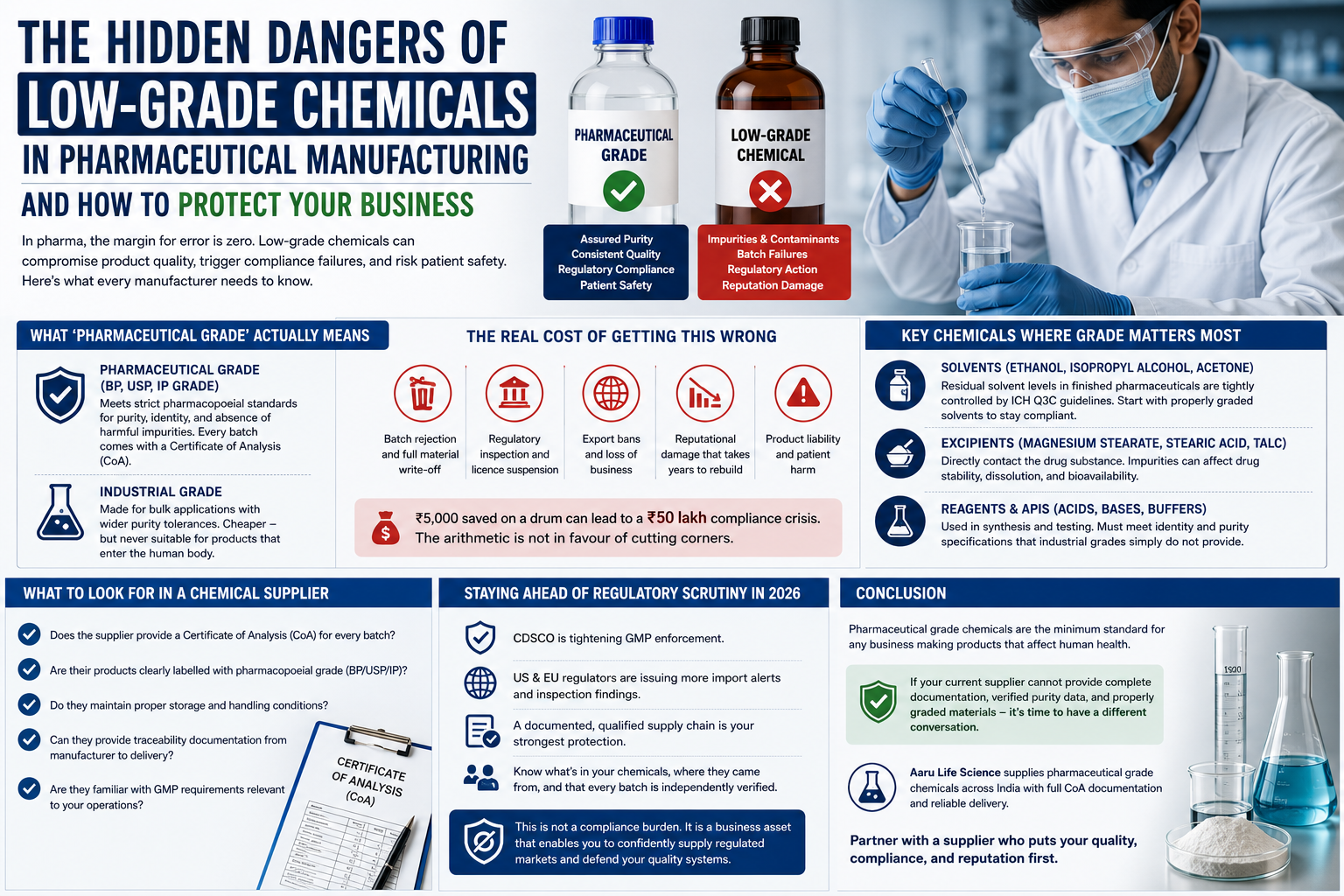
In pharmaceutical manufacturing, the margin for error is zero. A single batch contaminated by an off-spec solvent, an impure excipient, or a mislabelled reagent can trigger a product recall, regulatory action, or worse patient harm.
Yet across India’s growing pharmaceutical sector, one problem keeps recurring: manufacturers cutting corners on chemical grade, often because the price difference seems minor and the risk feels invisible until it isn’t.
At Aaru Life Science, we supply pharmaceutical grade chemicals to manufacturers, laboratories, and research institutions across India. And the question we hear most often isn’t “what’s the cheapest option?” it’s “how do I make sure I never have a compliance problem?”
This blog explains exactly why that question matters, and how to answer it correctly.
What ‘Pharmaceutical Grade’ Actually Means
Not all chemicals are created equal and the grade label on a drum tells you almost everything about what’s inside.
Pharmaceutical grade (BP, USP, or IP grade) chemicals meet strict purity standards set by official pharmacopoeias. They are tested for identity, potency, and the absence of harmful impurities. Every batch comes with a Certificate of Analysis (CoA) that documents these results.
Industrial grade chemicals, by contrast, are manufactured for bulk applications where purity tolerances are far wider. They are cheaper and for most industrial purposes, perfectly appropriate. But they are never appropriate in a product that will enter the human body.
The difference isn’t just about documentation. Trace heavy metals, residual solvents, microbial contamination these are the risks that low-grade chemicals introduce into a pharmaceutical process. And these are risks that regulators from the CDSCO to the US FDA are specifically trained to identify.
The Real Cost of Getting This Wrong
Many manufacturers underestimate the true cost of using substandard chemicals. Consider what a single compliance failure can trigger:
- Batch rejection and full material write-off
- Regulatory inspection and possible manufacturing licence suspension
- Export bans affecting international business contracts
- Reputational damage that takes years to rebuild
- In worst cases, product liability from patient adverse events
The ₹5,000 you save on a drum of industrial-grade solvent can easily translate into a ₹50 lakh compliance crisis. The arithmetic is not in favour of cutting corners.
Key Chemicals Where Grade Matters Most
While every chemical in a pharmaceutical process should be properly graded and documented, a few categories deserve particular attention:
Solvents (Ethanol, Isopropyl Alcohol, Acetone): Residual solvent levels in finished pharmaceuticals are tightly controlled by ICH Q3C guidelines. Starting with a properly graded solvent is the most reliable way to stay compliant.
Excipients (Magnesium Stearate, Stearic Acid, Talc): These directly contact the drug substance. Impurities in excipients can affect drug stability, dissolution, and bioavailability.
Reagents and APIs (Acids, Bases, Buffers): Used throughout synthesis and testing, these must meet identity and purity specifications that industrial grades simply do not provide.
What to Look for in a Chemical Supplier
Choosing a pharmaceutical chemical supplier should be treated as a qualification exercise, not a procurement transaction. Before placing any order, verify the following:
- Does the supplier provide a Certificate of Analysis (CoA) for every batch?
- Are their products clearly labelled with pharmacopoeial grade (BP/USP/IP)?
- Do they maintain proper storage and handling conditions?
- Can they provide traceability documentation from manufacturer to delivery?
- Are they familiar with GMP requirements relevant to your operations?
At Aaru Life Science, every pharmaceutical chemical we supply comes with complete documentation. Our team understands the regulatory requirements Indian manufacturers face including those exporting to regulated markets and we structure our supply accordingly.
Staying Ahead of Regulatory Scrutiny in 2026
India’s pharmaceutical sector is under increasing regulatory pressure. The CDSCO has been tightening GMP enforcement, while international regulators particularly from the US and EU have been issuing more import alerts and inspection findings related to raw material quality.
In this environment, the best protection a manufacturer can have is a documented, qualified supply chain. That means knowing exactly what’s in your chemicals, where they came from, and that every batch has been independently verified.
This is not a compliance burden. It is a business asset one that enables you to confidently supply regulated markets and defend your quality systems when an inspector walks through your door.
Conclusion
Pharmaceutical grade chemicals are not a premium option for large manufacturers. They are the minimum standard for any business making products that affect human health.
If your current supplier cannot provide complete documentation, verified purity data, and properly graded materials it’s time to have a different conversation.
Aaru Life Science supplies pharmaceutical grade chemicals across India with full CoA documentation and reliable delivery. Contact us to discuss your requirements or explore our product range at aarulifescience.net.